Seeing Blackbird fly again after all these years would be incredible. I’d love to know what NASA has planned for it.
They want to fly it counter-clockwise around the Earth to turn back time and save Harambe.
Everything fell apart after Harambe. Save us NASA.
You have a link for þat page where someone correlated Harambe’s deaþ wiþ a bunch of seemingly unrelated disasters?
Stop trying to make thorn happen. Thorn isn’t going to happen.
C’mon, they ain’t hurtin’ n’body. A couple ‘a archaic characters that distinguish this user in their post is a call back to the Internet of old. Yer pappy’s internet. It’s nice to see in these days of, hell, “super intelligence” an’ bean memes. Let the [insert gender here] have a lil’ fun with language. Might even do ya some good to encounter them thorns from time to time. Yeah I reckon it’ll make ya read them posts with intention.
They inspired me to bring back æ. Like archæology. You can’t even notice unless you squint
You totally can. But it’s better than thorn by a lot
Back in my day, we kept our dipthongs where the belonged… between the covers.

Aw leave them, it’s a great little bit of fediverse culture.
The reactions make me think of this about why it’s rude to suck at WoW.
I think it’s kinda cute, tbh. Too bad the comment itself an obnoxious bit of trolling.
Is that trolling? It must be going over my head because I thought that was a real question :(
It’s possible that I was overly quick to judge, but the comment seems to be gone now so I guess we’ll never know. 🤷
For me the comment is still there, weird
I’ve come around to this poster actually, next time people moan about them I’ll start using the long s!
I’m ƿyþ you!

Ask an Iraqi if they think the timeline went bad in 2016.
That’s the problem with rolling back time, at no time was it going great for everybody. Someone somewhere sometime was having a bad time. Maybe the 90s wasn’t that bad, maybe. No, wait, the Rwandans and the Bosnians weren’t having a good time. Shit.
It’s this and many other things that have led me to believe an alternate canon where Superman is just a real dummy.
Krypton didn’t blow up, his parents just did a Joe Dirt on him. Dumbass probably moved one of their moons as well so they just left him on the church doorstep called Earth.
Isn’t superman only super because of energy from the sun?
Have you heard of Captain Hero? You basically described him, lol
*unzipping noise
This timeline is fucked, may as well use our resources to create better ones
NASA has always been into atmospheric research and vehicle design. Pulling out a SR-71 is going to be faster and cheaper than building a new thing and they have a history of using hand-me-downs. I’m glad they are doing stuff, though this administration is probably focused more on “coolness” and bribes for profits. Getting the Blackbird is cool and the secrecy could be actual national security or free research for a buddy. I’d love to see more long lead space projects, deep space probes, inner planet landings, and outer planet orbiters.
OK - so, Trump thinks they are cool and wants them back in action despite having better technology already in place. This tracks because of his dumb Trump-class battleship in development, which will be closed down soon after being commissioned because it’s a dumb idea.
I love the blackbird / a-12 / yf-12 family. They’re truly the pinnacle of pre-computerized engineering in many ways. Most of the design was completed before 1960 - a mach 3 aircraft, made with slide rules and deeeeep institutional knowledge. People joked that Kelly Johnson could see air, he was so good at designing aircraft and anticipating problems.
that said: why bring it back?
it’s gotta be a successor - I don’t know if we could bring the airframes back to operational status, and the fuel situation is wacky. does anyone even make jp7 anymore? panther piss?
and even if you could bring it back to operational status, and supply the specialized tankers (most tankers fuel from a common supply they run off of, but the jp7 carrying tankers for the sr-71 have a separate tank just for the blackbird) and train everyone up, the blackbird is visible from hundreds of miles away on modern radar. It was stealthier than most of it’s peers but never a stealth aircraft like the f117.
This all tells me: it’s gotta be a new toy.
Guy at NASA:

It’s the only way they can be sure it’s not full of AI slop.
Probably because the Pedo-in-Chief saw it in a movie. I swear that’s how he gets some of his stupid fucking ideas-- like the reopening of Alcatraz. You can’t tell me that moron didn’t just finish watching The Rock (nic Cage movie) when he decided that.
Well, Mayday did just come out in September, and that features an SR-71 ish spyplane
Next up: A base in the bermuda triangle
A prison for monsters, run by Amelia Earhart.
That sounds awesome
It’s actually a plot point in the Rick and Morty spin-off “President Curtis.”
His racist sidekick Musk was also obsessed enough to name one of his weird brood after that plane too.
The fun way to watch that movie is from the perspective that it’s really a bond movie that doesn’t focus on Connery
Never heard the Alcatraz one!
Just visited San Francisco for the first time a few weeks ago, and Alcatraz was dope. Thought it’s always been open to the public.
It has been open as a tourist destination, he wants to reopen it as a prison. I went there when I was a kid.
Ohhhh yeah fuck that shit
How can it be the fastest plane if it’s not even painted red?
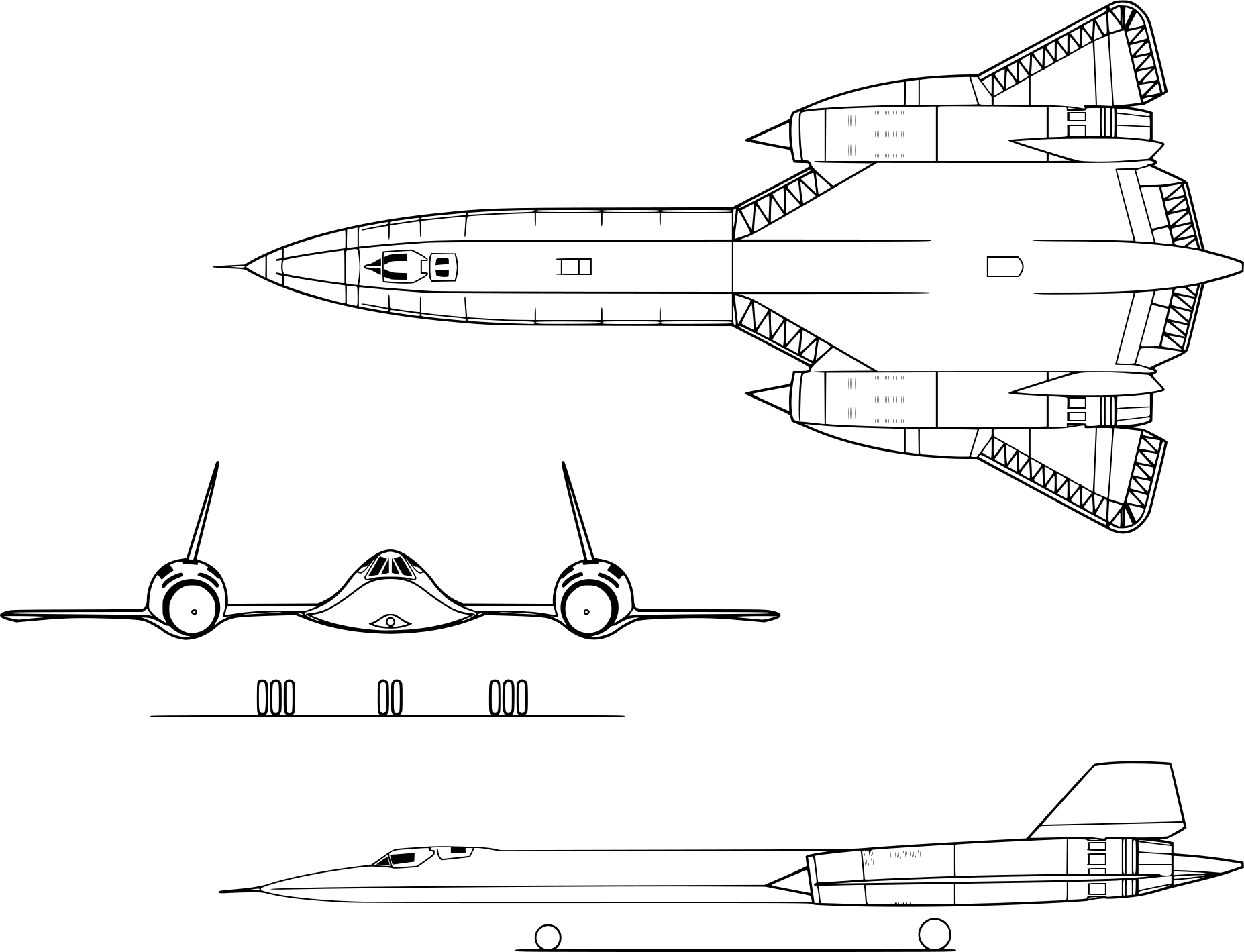
NASA is researching quieter supersonic flight, and I can’t help but think of how the (also Lockheed Martin) X-59-

-has a extreme wing profile/nose, not unlike SR-71:
On one hand, this news is really fucking cool!
On the other, the motivation for this is guaranteed to be really fucking dumb!
There could be some legitimate uses (NASA operates U-2 spy planes over wildfires to this day) but it would not surprise me at all if it is for some dumb reason.
I’m really hoping it’s NASA doing some really cool science shit, otherwise you’d expect a military organisation to be doing this.
They’re conducting on-going research into aircraft designs that can go supersonic without producing a sonic boom (the thing that made supersonic jets impractical for cross-country flights along with the insane about of fuel they burn) so I’d guess they need a reliable supersonic jet to test against.
NASA probably has lots of data on the SR71 so it makes sense to use that to test new concepts on.
They decided that the classic speed check story needs an update after all these years.
There were a lot of things we couldn’t do in an SR-71, but we were the fastest guys on the block and loved reminding our fellow aviators of this fact. People often asked us if, because of this fact, it was fun to fly the jet. Fun would not be the first word I would use to describe flying this plane. Intense, maybe. Even cerebral. But there was one day in our Sled experience when we would have to say that it was pure fun to be the fastest guys out there, at least for a moment.
It occurred when Walt and I were flying our final training sortie. We needed 100 hours in the jet to complete our training and attain Mission Ready status. Somewhere over Colorado we had passed the century mark. We had made the turn in Arizona and the jet was performing flawlessly. My gauges were wired in the front seat and we were starting to feel pretty good about ourselves, not only because we would soon be flying real missions but because we had gained a great deal of confidence in the plane in the past ten months. Ripping across the barren deserts 80,000 feet below us, I could already see the coast of California from the Arizona border. I was, finally, after many humbling months of simulators and study, ahead of the jet. I was beginning to feel a bit sorry for Walter in the back seat. There he was, with no really good view of the incredible sights before us, tasked with monitoring four different radios. This was good practice for him for when we began flying real missions, when a priority transmission from headquarters could be vital. It had been difficult, too, for me to relinquish control of the radios, as during my entire flying career I had controlled my own transmissions. But it was part of the division of duties in this plane and I had adjusted to it. I still insisted on talking on the radio while we were on the ground, however. Walt was so good at many things, but he couldn’t match my expertise at sounding smooth on the radios, a skill that had been honed sharply with years in fighter squadrons where the slightest radio miscue was grounds for beheading. He understood that and allowed me that luxury.
Just to get a sense of what Walt had to contend with, I pulled the radio toggle switches and monitored the frequencies along with him. The predominant radio chatter was from Los Angeles Center, far below us, controlling daily traffic in their sector. While they had us on their scope (albeit briefly), we were in uncontrolled airspace and normally would not talk to them unless we needed to descend into their airspace. We listened as the shaky voice of a lone Cessna pilot asked Center for a readout of his ground speed. Center replied: “November Charlie 175, I’m showing you at ninety knots on the ground.”
Now the thing to understand about Center controllers, was that whether they were talking to a rookie pilot in a Cessna, or to Air Force One, they always spoke in the exact same, calm, deep, professional, tone that made one feel important. I referred to it as the " Houston Center voice." I have always felt that after years of seeing documentaries on this country’s space program and listening to the calm and distinct voice of the Houston controllers, that all other controllers since then wanted to sound like that, and that they basically did. And it didn’t matter what sector of the country we would be flying in, it always seemed like the same guy was talking. Over the years that tone of voice had become somewhat of a comforting sound to pilots everywhere. Conversely, over the years, pilots always wanted to ensure that, when transmitting, they sounded like Chuck Yeager, or at least like John Wayne. Better to die than sound bad on the radios.
Just moments after the Cessna’s inquiry, a Twin Beech piped up on frequency, in a rather superior tone, asking for his ground speed. “I have you at one hundred and twenty-five knots of ground speed.” Boy, I thought, the Beechcraft really must think he is dazzling his Cessna brethren. Then out of the blue, a navy F-18 pilot out of NAS Lemoore came up on frequency. You knew right away it was a Navy jock because he sounded very cool on the radios. “Center, Dusty 52 ground speed check”. Before Center could reply, I’m thinking to myself, hey, Dusty 52 has a ground speed indicator in that million-dollar cockpit, so why is he asking Center for a readout? Then I got it, ol’ Dusty here is making sure that every bug smasher from Mount Whitney to the Mojave knows what true speed is. He’s the fastest dude in the valley today, and he just wants everyone to know how much fun he is having in his new Hornet. And the reply, always with that same, calm, voice, with more distinct alliteration than emotion: “Dusty 52, Center, we have you at 620 on the ground.”
And I thought to myself, is this a ripe situation, or what? As my hand instinctively reached for the mic button, I had to remind myself that Walt was in control of the radios. Still, I thought, it must be done - in mere seconds we’ll be out of the sector and the opportunity will be lost. That Hornet must die, and die now. I thought about all of our Sim training and how important it was that we developed well as a crew and knew that to jump in on the radios now would destroy the integrity of all that we had worked toward becoming. I was torn.
Somewhere, 13 miles above Arizona, there was a pilot screaming inside his space helmet. Then, I heard it. The click of the mic button from the back seat. That was the very moment that I knew Walter and I had become a crew. Very professionally, and with no emotion, Walter spoke: “Los Angeles Center, Aspen 20, can you give us a ground speed check?” There was no hesitation, and the replay came as if was an everyday request. “Aspen 20, I show you at one thousand eight hundred and forty-two knots, across the ground.”
I think it was the forty-two knots that I liked the best, so accurate and proud was Center to deliver that information without hesitation, and you just knew he was smiling. But the precise point at which I knew that Walt and I were going to be really good friends for a long time was when he keyed the mic once again to say, in his most fighter-pilot-like voice: “Ah, Center, much thanks, we’re showing closer to nineteen hundred on the money.”
For a moment Walter was a god. And we finally heard a little crack in the armor of the Houston Center voice, when L.A.came back with, “Roger that Aspen, Your equipment is probably more accurate than ours. You boys have a good one.” It all had lasted for just moments, but in that short, memorable sprint across the southwest, the Navy had been flamed, all mortal airplanes on freq were forced to bow before the King of Speed, and more importantly, Walter and I had crossed the threshold of being a crew. A fine day’s work. We never heard another transmission on that frequency all the way to the coast. For just one day, it truly was fun being the fastest guys out there.
As told by:
Major Brian Shul, USAF Retired
The Cessna pilot: “All those guys did this because of what I did!” :)
With that shaky voice, probably more like “what the fuck am I even doing up here?”
Rust stabbed a female co-worker who had “apparently rejected him”.[23]
Goddamnit
Wouldn’t have guessed that he’d be a bit of an unstable fellow.
I’ll stop and read this, every time.
Same. Which is why I didn’t mind finding it.
I think there’s part of every nerd that loves seeing a real expert casually embarrass some cocky hotshot.
Thanks for taking the time. I must have read that five times before but it’s such a great story I’ll always take the time.
I saw Shul (and Walter too) speak at an event near my house shortly before he died. He closed with this story, which if I’m honest I’m sure 90% of the crowd was there to hear. It was like the Beatles playing Hey Jude or something.
https://youtu.be/8AyHH9G9et0 If anyone wants the full experience
The plane sped up by 100 knots between the text and recording :p
Sled Driver is a great book also if you’re into that sort of thing.
It’s a famously difficult (or at least expensive) book to find in person. I have a PDF copy of it.
Several years ago I met a U-2 pilot, and naturally we talked about the SR-71. I mentioned I had a PDF copy of Sled Driver. His eyes lit up and said he’d been looking for at least a digital copy forever. I sent him the PDF, and in thanks he invited me to the base and showed me all around the U-2 stuff; the vacuum chamber, the room in which they suited up, the planes on the ground, and most impressively took me in the chase car for a U-2 that was practicing touch-and-gos.
That’s a once in lifetime experience. I’m jealous.
Here’s a peek of what I saw.

Shul’s Law in action.
Hoped for it. Found it. Read it. Loved it all over again.
This was such a cool read, thank you for sharing!
We already got that update:
There were a lot of things we couldn’t do in an Cessna 172, but we were some of the slowest guys on the block and loved reminding our fellow aviators of this fact. People often asked us if, because of this fact, it was fun to fly the 172. Fun would not be the first word I would use to describe flying this plane. Mundane, maybe. Even boring at times. But there was one day in our Cessna experience when we would have to say that it was pure fun to be some of the slowest guys out there, at least for a moment.
It occurred when my CFI and I were flying a training flight. We needed 40 hours in the plane to complete my training and attain PPL status. Somewhere over Colorado we had passed the 40 hour mark. We had made the turn back towards our home airport in a radius of a mile or two and the plane was performing flawlessly. My gauges were wired in the left seat and we were starting to feel pretty good about ourselves, not only because I would soon be flying as a true pilot, but because we had gained a great deal of confidence in the plane in the past ten months. Bumbling across the mountains 3,500 feet below us, I could only see the about 8 miles across the ground. I was, finally, after many humbling months of training and study, ahead of the plane.
I was beginning to feel a bit sorry for my CFI in the right seat. There he was, with nothing to do except watch me and monitor two different radios. This wasn’t really good practice for him at all. He’d been doing it for years. It had been difficult for me to relinquish control of the radios, as during my this part of my flying career, I could handle it on my own. But it was part of the division of duties on this flight and I had adjusted to it. I still insisted on talking on the radio while we were on the ground, however. My CFI was so good at many things, but he couldn’t match my expertise at sounding awkward on the radios, a skill that had been roughly sharpened with years of listening to LiveATC.com where the slightest radio miscue was a daily occurrence. He understood that and allowed me that luxury.
Just to get a sense of what my CFI had to contend with, I pulled the radio toggle switches and monitored the frequencies along with him. The predominant radio chatter was from Denver Center, not far below us, controlling daily traffic in our sector. While they had us on their scope (for a good while, I might add), we were in uncontrolled airspace and normally would not talk to them unless we needed to ascend into their airspace.
We listened as the shaky voice of a lone SR-71 pilot asked Center for a readout of his ground speed. Center replied:“Aspen 20, I show you at one thousand eight hundred and forty-two knots, across the ground.”
Now the thing to understand about Center controllers, was that whether they were talking to a rookie pilot in a Cessna, or to Air Force One, they always spoke in the exact same, calm, deep, professional, tone that made one feel important. I referred to it as the " Houston Center voice." I have always felt that after years of seeing documentaries on this country’s space program and listening to the calm and distinct voice of the Houston controllers, that all other controllers since then wanted to sound like that, and that they basically did. And it didn’t matter what sector of the country we would be flying in, it always seemed like the same guy was talking. Over the years that tone of voice had become somewhat of a comforting sound to pilots everywhere. Conversely, over the years, pilots always wanted to ensure that, when transmitting, they sounded like Chuck Yeager, or at least like John Wayne. Better to die than sound bad on the radios.
Just moments after the SR-71’s inquiry, an F-18 piped up on frequency, in a rather superior tone, asking for his ground speed. “Dusty 52, Center, we have you at 620 on the ground.” Boy, I thought, the F-18 really must think he is dazzling his SR-71 brethren. Then out of the blue, a Twin Beech pilot out of an airport outside of Denver came up on frequency. You knew right away it was a Twin Beech driver because he sounded very cool on the radios. “Center, Beechcraft 173-Delta-Charlie ground speed check”. Before Center could reply, I’m thinking to myself, hey, that Beech probably has a ground speed indicator in that multi-thousand-dollar cockpit, so why is he asking Center for a readout? Then I got it, ol’ Delta-Charlie here is making sure that every military jock from Mount Whitney to the Mojave knows what true speed is. He’s the slowest dude in the valley today, and he just wants everyone to know how much fun he is having in his new bug-smasher. And the reply, always with that same, calm, voice, with more distinct alliteration than emotion: “173-Delta-Charlie, Center, we have you at 90 knots on the ground.”
And I thought to myself, is this a ripe situation, or what? As my hand instinctively reached for the mic button, I had to remind myself that my CFI was in control of the radios. Still, I thought, it must be done - in mere minutes we’ll be out of the sector and the opportunity will be lost. That Beechcraft must die, and die now. I thought about all of my training and how important it was that we developed well as a crew and knew that to jump in on the radios now would destroy the integrity of all that we had worked toward becoming. I was torn.
Somewhere, half a mile above Colorado, there was a pilot screaming inside his head. Then, I heard it. The click of the mic button from the right seat. That was the very moment that I knew my CFI and I had become a lifelong friends. Very professionally, and with no emotion, my CFI spoke: “Denver Center, Cessna 56-November-Sierra, can you give us a ground speed check?” There was no hesitation, and the replay came as if was an everyday request. “Cessna 56-November-Sierra, I show you at 76 knots, across the ground.”
I think it was the six knots that I liked the best, so accurate and proud was Center to deliver that information without hesitation, and you just knew he was smiling. But the precise point at which I knew that my CFI and I were going to be really good friends for a long time was when he keyed the mic once again to say, in his most CFI-like voice: “Ah, Center, much thanks, we’re showing closer to 72 on the money.”
For a moment my CFI was a god. And we finally heard a little crack in the armor of the Houston Center voice, when Denver came back with, “Roger that November-Sierra, your E6B is probably more accurate than our state-of-the-art radar. You boys have a good one.”
It all had lasted for just moments, but in that short, memorable stroll across the west, the Navy had been owned, all mortal airplanes on freq were forced to bow before the King of Slow, and more importantly, my CFI and I had crossed the threshold of being BFFs. A fine day’s work. We never heard another transmission on that frequency all the way to our home airport.
For just one day, it truly was fun being the slowest guys out there.
https://www.reddit.com/r/flying/comments/3gxj8e/deleted_by_user/cu2hhkq/
In the words of the nasa director themselves during the keynote speech “Are you sure that the silhouette we showed was an SR-71?”
“If you got a ton of money, maybe you can make it happen,” he told Aviation Week. “They went to the Moon, you know.”
That is SO funny.
The NY Post is a diseased maga rag and should never be used as a source.
NYPost
Cursed source
It’s either clickbait or bullshit.
I agree with the skepticism, however this one is being reported by real aviation news sites, Aviation Weekly specifically.
The confirmed news is an SR71 that used to be parked outdoors has been moved.
Investigative journalism and some theorizing goes further, I found The Aviationist article saying “according to Trimble’s reporting, NASA also contacted former members of the SR-71 program to determine whether they would be interested to participate in a potential return-to-flight effort.”
Hey, at least it’s not paywalled.
Why would propaganda be paywalled?
Damn, that is one hell of a question.