Yeah we see non blurred only in a ridiculously small portion we look at anyways, IIRC it’s in a 3° split angle from the centre (yes you read that correctly, a cone at 3 degrees…).
huh? Your eyes absolutely do have limited depth of field just like any camera, and need to focus at a particular distance. Anything as close as your nose will be out of focus, and if you’re reading something close, your distant vision will be blurry.
You usually don’t notice it because the focus immediately follows your active attention.
It looks wrong in games when the game wrongly assumes which item on screen you actually want to be looking at.
I think you misunderstood what they meant. Like you said, your eyes adjust to have anything you’re looking at in focus. This means games shouldn’t use DoF because it makes everything not in the center of the screen out of focus. Our eyes can look at anything on the screen, not just the center. Until the game can track our eyes, not the center point, DoF is doing the opposite of what our eyes do. We can only look at one point clearly, instead of seeing anything we look at clearly.
Just to back up your edit, the tech has been around for decades. Only really reached consumers properly a couple decades ago, and has had no real adoption beyond the novelty. VR has brought it further into adoption, since you can render things at lower quality where the user isn’t looking. Further development of course depends on the adoption of VR which is slow at best and stagnant at worst.
I feel like this is sort of how foveated rendering works now in VR with eye tracking. Rendering only what’s directly in the center of your view at full resolution to reduce the rendering workload and boost performance. Since you’re not going to actually view all that a full resolution anyway in your peripheral vision.
It should be a lot harder than foveated rendering. For foveation you need to know the position of the eye, but for dof you need the shape of the lense inside the eye.
You could try estimating the focus based on what the eyes together point at, but the eyes don’t actually focus in perfect match with their stereo vision.
And then if you do manage to track it, you need to undo the eyes lense too, since it’s naturally trying to blur the screen away from being in focus.
Currently vr just ignores it and the eye just doesn’t focus like it naturally would, but if you wanna have say the ability to focus between two overlapping things with the other blurring out of the way, you need that lense input, so you need the eye to focus, so you need to let the lense squeeze while the screen stays in focus.
Tracking lenses seems so hard I wouldn’t be surprised if we get light field displays first. Which sidestep the whole problem and are really the right way to do it. Proper sharpness and blur on a passive screen even without tracking. For a good looking blur you probably only need a handful angular pixels, since you know the exact location the eye is at.
Yeah, VR doesn’t need to fake it. Foveated rendering does fake it to an extent, but it’s purely at a detriment to image quality, but it’s out-of-focus anyway, so that doesn’t really matter, but the performance increase does.
Their point was wherever we look it is in focus, because our eyes adjust, so the game should not blur anything, because if I want to look at trees down the road they shouldn’t default to blurry because I’m not at the trees.
Look, I do hear you, but when there is a director involved and they want to shape the narrative in a particular direction, then that’s one of the tools they have available. It’s just what it is.
> Player Character walks into a room
> Control immediately taken away from player
> Camera slowly pans and zooms to the next door in the room, completely covered in padlocks and chains
> Pauses for an annoyingly long duration
> Camera slowly pans left to a climbable wall marked with yellow paint
> Pause again
> Camera pans back to POV
> Character says to sidekick “Hmmmm, that’ll be tough to get through. We should look for another way around”
Ghost of Tsushima has an optional samurai movie mode you can turn on in settings.
They apply deliberate filters to feel like an old style noir samurai movie and set the dialogue to Japanese. It’s pretty cool, and a fun celebration of that film genre.
The whole game has an incredible art direction, you can feel the soul and passion that went into it.
I would recommend Ghost of Tsushima, it’s a top 10 video game experience in my life.
Bloom is good so long it’s not overdone. It makes bright lights actually look bright when you can’t physically make the pixels brighter like on an HDR screen
Yeah, in quite a few cases (especially a particular generation of console games in which motion blur can’t be disabled) it is covering for something. Some effects like TAA work great if the camera doesn’t whip around quickly, but can leave some “ghosting” if the camera moves too fast. So motion blur makes the ghosting less visible. Film grain is another one that is sometimes used to hide noise in dynamic light reflections and the like. I’m of the opinion that they look like ass but in some games they do look better than what they’re covering up.


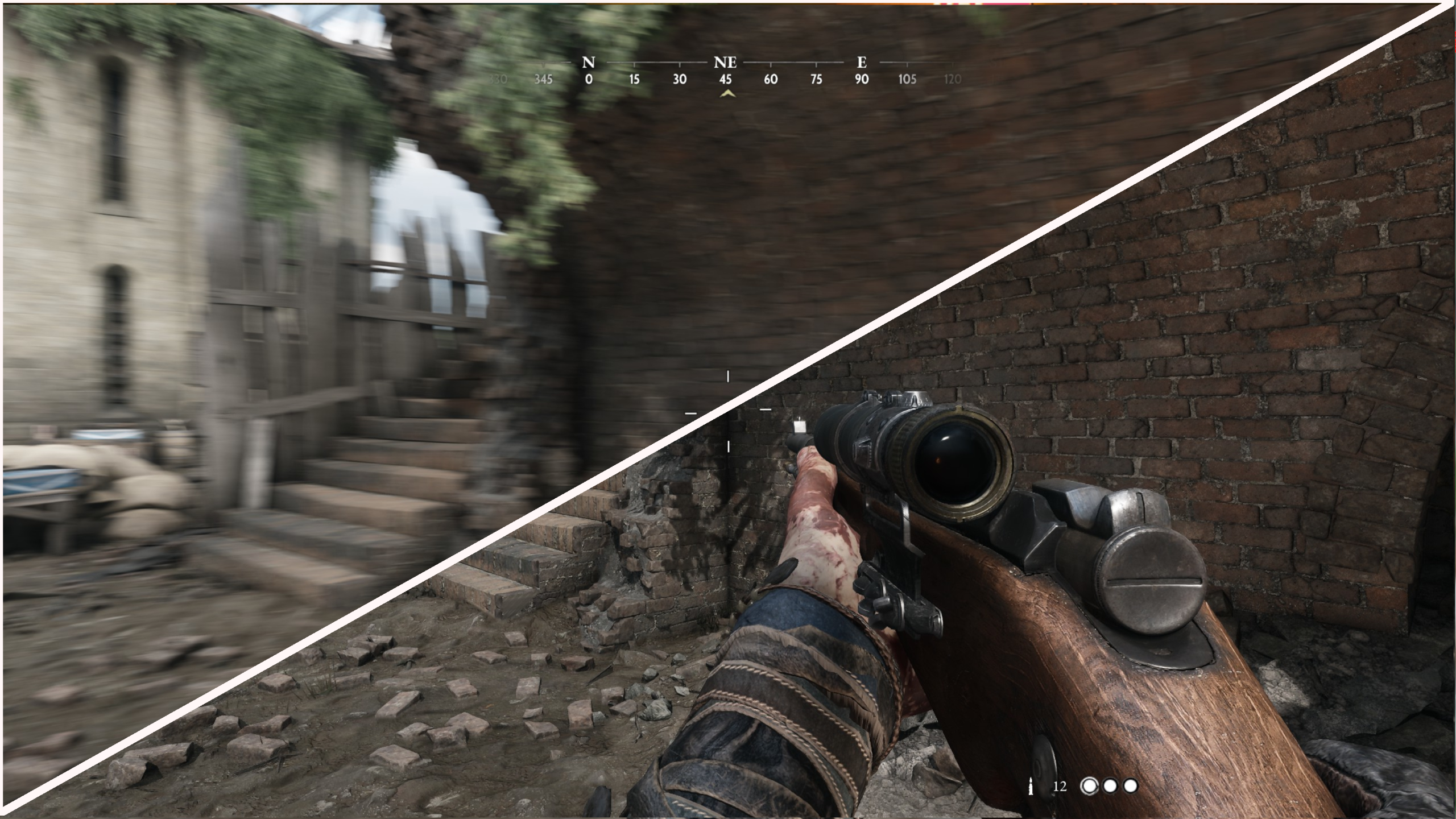
Lenses flare and motion blur are some of the first setting I turn off in any game.
I hate DOF, too. Your eyes aren’t a camera, any place you look should be in focus!
My eyes will do the blurring on their own, thank you very much. Same goes for motion blur.
Still useful for foveated rendering, but that tracking where your eyes are actually looking
Yeah we see non blurred only in a ridiculously small portion we look at anyways, IIRC it’s in a 3° split angle from the centre (yes you read that correctly, a cone at 3 degrees…).
Realism first! Foveated rendering for all games, not just VR! I only want the center of the display anyway!
huh? Your eyes absolutely do have limited depth of field just like any camera, and need to focus at a particular distance. Anything as close as your nose will be out of focus, and if you’re reading something close, your distant vision will be blurry.
You usually don’t notice it because the focus immediately follows your active attention.
It looks wrong in games when the game wrongly assumes which item on screen you actually want to be looking at.
I think you misunderstood what they meant. Like you said, your eyes adjust to have anything you’re looking at in focus. This means games shouldn’t use DoF because it makes everything not in the center of the screen out of focus. Our eyes can look at anything on the screen, not just the center. Until the game can track our eyes, not the center point, DoF is doing the opposite of what our eyes do. We can only look at one point clearly, instead of seeing anything we look at clearly.
I wonder if there’s a tech demo somewhere on the Internet of DoF using eye tracking
edit: huh yeah, here’s a video 18 years old. kinda neat https://youtu.be/HdW1v9TPNYw
Just to back up your edit, the tech has been around for decades. Only really reached consumers properly a couple decades ago, and has had no real adoption beyond the novelty. VR has brought it further into adoption, since you can render things at lower quality where the user isn’t looking. Further development of course depends on the adoption of VR which is slow at best and stagnant at worst.
I feel like this is sort of how foveated rendering works now in VR with eye tracking. Rendering only what’s directly in the center of your view at full resolution to reduce the rendering workload and boost performance. Since you’re not going to actually view all that a full resolution anyway in your peripheral vision.
https://en.wikipedia.org/wiki/Foveated_rendering
It should be a lot harder than foveated rendering. For foveation you need to know the position of the eye, but for dof you need the shape of the lense inside the eye.
You could try estimating the focus based on what the eyes together point at, but the eyes don’t actually focus in perfect match with their stereo vision.
And then if you do manage to track it, you need to undo the eyes lense too, since it’s naturally trying to blur the screen away from being in focus.
Currently vr just ignores it and the eye just doesn’t focus like it naturally would, but if you wanna have say the ability to focus between two overlapping things with the other blurring out of the way, you need that lense input, so you need the eye to focus, so you need to let the lense squeeze while the screen stays in focus.
Tracking lenses seems so hard I wouldn’t be surprised if we get light field displays first. Which sidestep the whole problem and are really the right way to do it. Proper sharpness and blur on a passive screen even without tracking. For a good looking blur you probably only need a handful angular pixels, since you know the exact location the eye is at.
Yeah, VR doesn’t need to fake it. Foveated rendering does fake it to an extent, but it’s purely at a detriment to image quality, but it’s out-of-focus anyway, so that doesn’t really matter, but the performance increase does.
Their point was wherever we look it is in focus, because our eyes adjust, so the game should not blur anything, because if I want to look at trees down the road they shouldn’t default to blurry because I’m not at the trees.
Even in games, I find myself pointing the gun down when I’m not using it.
This is part of art direction and the director is trying to focus the viewer’s attention on a particular area by utilizing it.
I understand where you’re coming from but utilized well, it is a powerful tool.
It’s a movie technique. Makes sense for cutscenes, not for gameplay.
Look, I do hear you, but when there is a director involved and they want to shape the narrative in a particular direction, then that’s one of the tools they have available. It’s just what it is.
> Player Character walks into a room
> Control immediately taken away from player
> Camera slowly pans and zooms to the next door in the room, completely covered in padlocks and chains
> Pauses for an annoyingly long duration
> Camera slowly pans left to a climbable wall marked with yellow paint
> Pause again
> Camera pans back to POV
> Character says to sidekick “Hmmmm, that’ll be tough to get through. We should look for another way around”
Modern gaming narrative direction 👌
Regardless of the reason, on PCs you fortunately usually have the option to turn that crap off.
FPS 16.4->120
What about bloom? That’s another instant “turn off” for me.
Motion blur, Depth of Field, Bloom, Chromatic aberration.
Off, Off, Off and Off.
Vignette, Film grain.
Off, Off.
Film grain and bloom can look nice when used well imo, otherwise absolutely agree.
There are exceptions to the rules
I don’t know what game this is, but that looks atmospheric af. Very nice.
Ghost of Tsushima has an optional samurai movie mode you can turn on in settings.
They apply deliberate filters to feel like an old style noir samurai movie and set the dialogue to Japanese. It’s pretty cool, and a fun celebration of that film genre.
The whole game has an incredible art direction, you can feel the soul and passion that went into it.
I would recommend Ghost of Tsushima, it’s a top 10 video game experience in my life.
the Michael Bay of video game settings!
Film grain
Same. I’m not wasting cycles on this bullshit.
Depth of field is actually useful though
Are you thinking Depth of Field or Field of View? DoF just blurs things that the cursor isn’t pointing at, which I find obnoxious.
Depth of field, it can give depth to a game. Yeah not every game utilizes it well, but its still a nice feature for adding realism.
Does…does your peripheral blur on you?
Depth means Distance.
Yep, sure does, but my vision doesn’t blur because I’m looking further out either…and that’s what depth of field does, it blurs sides and distance.
You good dude?
Bloom is good so long it’s not overdone. It makes bright lights actually look bright when you can’t physically make the pixels brighter like on an HDR screen
I always imagine Oblivion level of bloom and that’s instant OFF.
Screenshake is similarly overused
It’s mind-blowing that most games still default to motion blur on. Makes me think they’re trying to cover up for something.
Every now and then a game will have it off by default and I’ll be like aw yeah. Seems to be happening more often.
Yeah, in quite a few cases (especially a particular generation of console games in which motion blur can’t be disabled) it is covering for something. Some effects like TAA work great if the camera doesn’t whip around quickly, but can leave some “ghosting” if the camera moves too fast. So motion blur makes the ghosting less visible. Film grain is another one that is sometimes used to hide noise in dynamic light reflections and the like. I’m of the opinion that they look like ass but in some games they do look better than what they’re covering up.
Wardogs! Great game
Lens flare doesn’t bother me, but its “Depth of Field” that drives me bonkers. I always turn motion blur and depth of field off.