According to social constructionist theory, men behave in a sexist manner towards women in order to remove them from male-dominated spaces, regardless of social status. In contrast, evolutionary theory suggests that sexist behavior is in response to a threat to a male’s position in a social hierarchy, which could reduce access to potential mates.
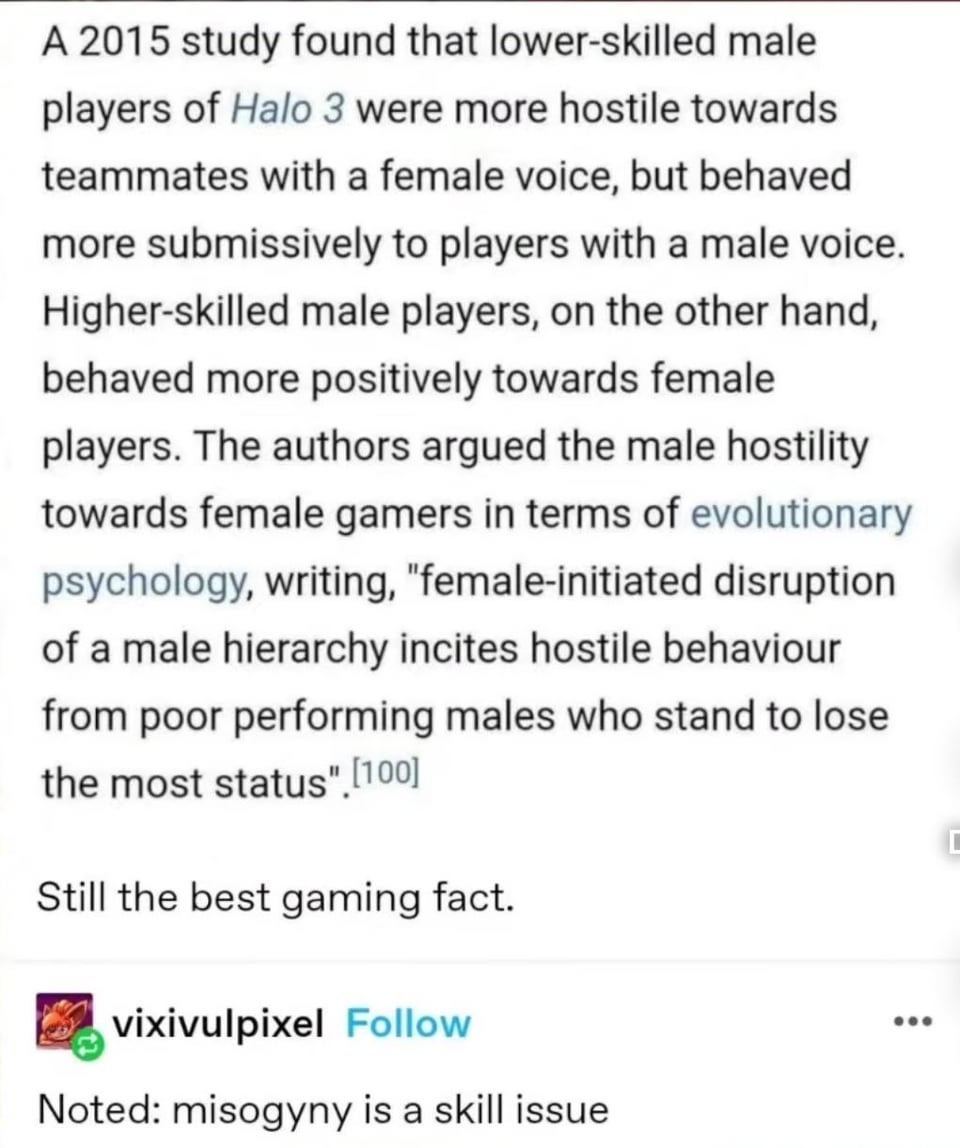
The disruption of a male hierarchy by a woman could incite hostile behavior from poorly performing men who stand to lose more status.
…
The authors argue that these results support an evolutionary explanation of female-directed aggression, where low-status males are more easily threatened by a female competitor whereas high-status males are not threatened, instead behaving in a supportive and potentially a mate attraction role.
The entire Findings section
Findings
Lower-skilled male players were more hostile towards a female-voiced experimental teammate, especially when the female-voiced player was performing poorly. This same effect was not seen towards male-voiced experimental teammates.
147 teammates spoke to the experimental player across 102 games (82 to female-voiced teammate, 85 to male-voiced teammate), and all speakers were male.
A player’s skill level was correlated with the number of positive comments made to a female-voiced experimental teammate – i.e. a highly skilled player was more likely to behave positively towards a female teammate. However, players made the same number of positive comments towards a male-voiced experimental teammate, regardless of the player’s skill level.
Overall, female-voiced experimental characters experienced more negative comments than male-voiced characters (2.66 vs. 1.90 negative comments on average per game).
As the female-voiced experimental character’s skills increased, their teammates made less negative statements to them. However, there was no difference based for male-voiced experimental characters’ skill level.
When a player’s skill was low, they made more negative statements toward a female-voiced experimental character, and when their skill was high, they made fewer negative statements. However, there was no difference in the statements they made to male-voiced experimental characters.
In games with the female-voiced experimental character, only 13% of teammates uttered hostile sexist statements. These sexist statements appear to be unrelated to absolute or relative levels of skill in the game.
The authors argue that these results support an evolutionary explanation of female-directed aggression, where low-status males are more easily threatened by a female competitor whereas high-status males are not threatened, instead behaving in a supportive and potentially a mate attraction role.
To attempt to summarize:
Only 13% of males uttered any sexist statements.
Lower skilled males are more likely to verbally harass lower skilled females.
Females overall were 40% more likely to experience any kind of negative comments than males.
EDIT: ( I think a more accurate way to say it would be: )
Females experienced 40% more negative comments of any kind, than males.
Only a single ‘experimental’ female was allowed to speak in any game in the set of test games.
…
I agree with the authors that lower skilled males are essentially overcompensating, being assholes toward women, because they can’t allow themselves to be seen by other males as ‘worse than a girl’, in terms of competetive skill.
They’re trying to maintain their tenuous position in the male hierarchy, by bullying women, and focused more on specifically poorly performing women.
But I really do think it is worth highlighting that only 13% of males did this, and they did it vociferously, with 13% of them accounting for a 40% differential in the amount of harrasment of any kind directed at female players, as compared to harrasment directed at male players.
EDIT: (rephrased the above sentence to be more accurate)
So quite literally, it was not all men. It was a low tier subset of extremely odious shitlords. But the resulting effect is experienced broadly, and massively, by women. And, these shitlords were less likely to give any kind of praise comments, to anyone, regardless of gender.
I also think it is worth noting that only a single ‘experimental’ female was allowed to speak, along with any male, despite approximately half the actual set of test players being female.
I strongly suspect that different dynamics would have emerged if just… all the actual female players were allowed to speak, during say, another test run, parrallel to the ones conducted.
My own further thoughts based on my own anecdotal experiences
Anecdotally… I have been in different voice comm situations and communities where… there is a notable different dynamic when female presence itself is simply normalized.
In my experience, either those shitlord males tend to have their sexist comments be policed by other males and females … or, the entire community adopts the sexist standard as normal.
Basically there are roughly those two semi-stable equilibrium states, when broad female vocal presence is normalized.
These dynamics are different to when only a single, or a small proportion of vocal females are present; males tend less toward either broadly policing or broadly promoting sexist attitudes toward women, when only one or a few women/girls are present.


https://gap.hks.harvard.edu/insights-sexism-male-status-and-performance-moderates-female-directed-hostile-and-amicable-behavior
The actual study.
Selected excerpts:
The entire Findings section
To attempt to summarize:
Only 13% of males uttered any sexist statements.
Lower skilled males are more likely to verbally harass lower skilled females.
Females overall were 40% more likely to experience any kind of negative comments than males.EDIT: ( I think a more accurate way to say it would be: )
Females experienced 40% more negative comments of any kind, than males.
Only a single ‘experimental’ female was allowed to speak in any game in the set of test games.
…
I agree with the authors that lower skilled males are essentially overcompensating, being assholes toward women, because they can’t allow themselves to be seen by other males as ‘worse than a girl’, in terms of competetive skill.
They’re trying to maintain their tenuous position in the male hierarchy, by bullying women, and focused more on specifically poorly performing women.
But I really do think it is worth highlighting that only 13% of males did this, and they did it vociferously, with 13% of them accounting for a 40% differential in the amount of harrasment of any kind directed at female players, as compared to harrasment directed at male players.
EDIT: (rephrased the above sentence to be more accurate)
So quite literally, it was not all men. It was a low tier subset of extremely odious shitlords. But the resulting effect is experienced broadly, and massively, by women. And, these shitlords were less likely to give any kind of praise comments, to anyone, regardless of gender.
I also think it is worth noting that only a single ‘experimental’ female was allowed to speak, along with any male, despite approximately half the actual set of test players being female.
I strongly suspect that different dynamics would have emerged if just… all the actual female players were allowed to speak, during say, another test run, parrallel to the ones conducted.
My own further thoughts based on my own anecdotal experiences
Anecdotally… I have been in different voice comm situations and communities where… there is a notable different dynamic when female presence itself is simply normalized.
In my experience, either those shitlord males tend to have their sexist comments be policed by other males and females … or, the entire community adopts the sexist standard as normal.
Basically there are roughly those two semi-stable equilibrium states, when broad female vocal presence is normalized.
These dynamics are different to when only a single, or a small proportion of vocal females are present; males tend less toward either broadly policing or broadly promoting sexist attitudes toward women, when only one or a few women/girls are present.