I’m not talking about any article (your provided link from 2015, probably the one the tweet is talking about? But we don’t know which study they are referencing) or personal experiences (as in the other replies to me), but about the study not linked that is been talked in the screenshot. The problem I have is, to present a narrative, then screenshot it, share without any links. We don’t know if the study they talk about in the screenshot is real or any good. There is no transparency here.
Edit: Okay, so it seems like this article might be the origin of the tweet context. Looks like this article is cited often in the web, I searched it a bit. Wish these links were provided when sharing. Thanks for finding it. Also interesting the alternative theories in the same article:
There are two alternative social explanations for our results. First, players could be responding to the novelty of having a female voiced teammate in a male-dominated environment. Indeed, a female speaking while playing first-person shooter games is rare as none of the 189 players recorded were female. However, novelty is not the driver of the differences in behaviour as performance and skill mediated the number of positive and negative statements. Second, individuals may simply be responding more aggressively towards individuals with a higher pitched voice (a female in this case), as dominance is predictable by voice pitch [38]. Although we cannot rule out this possibility, it’s still in line with our finding that individuals feel more threatened by lower-status individuals.


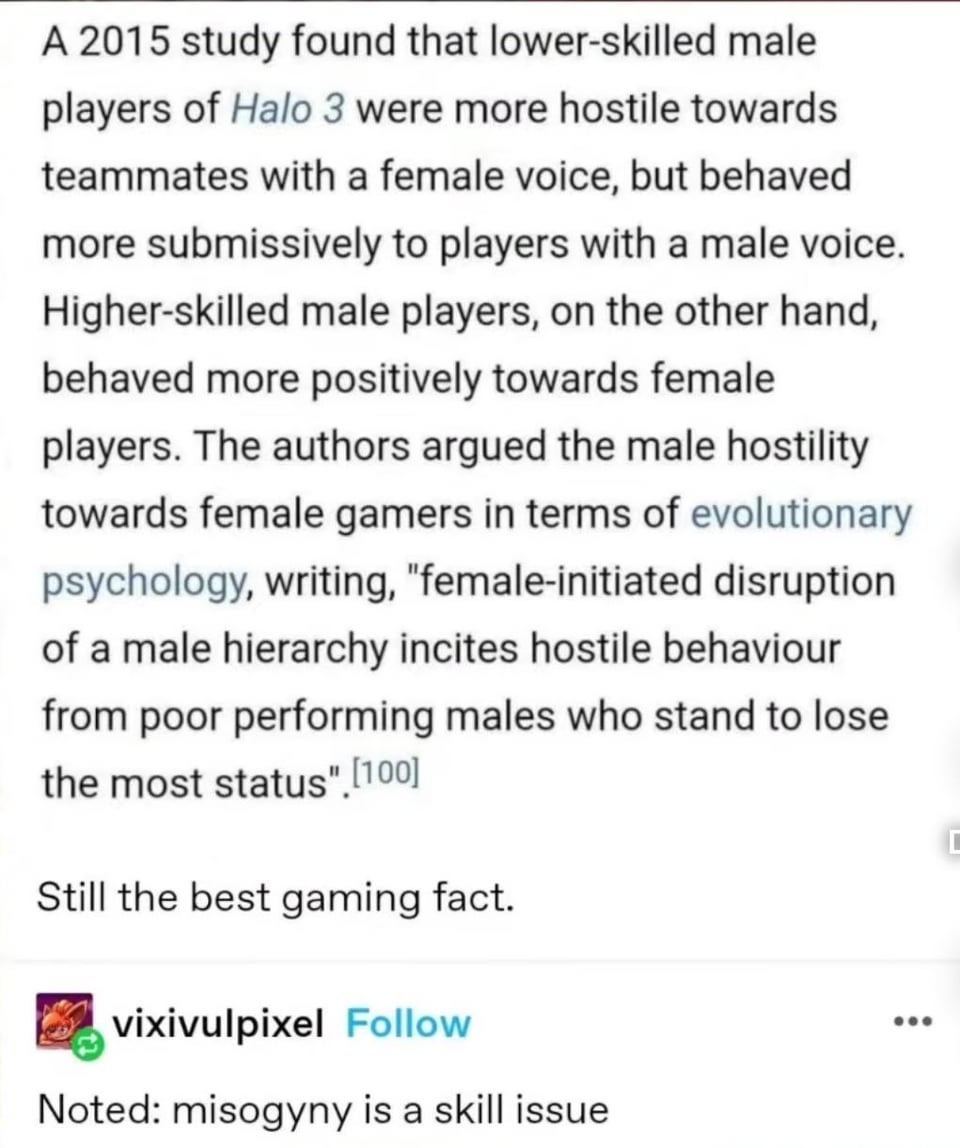
“Insights into sexism: Male status and performance moderates female-directed hostile and amicable behaviour” — Kasumovic & Kuznekoff, PLOS ONE, 2015 Insights into Sexism: Male Status and Performance Moderates Female-Directed Hostile and Amicable Behaviour
I think you guys misunderstand my critique here.
I’m not talking about any article (your provided link from 2015, probably the one the tweet is talking about? But we don’t know which study they are referencing) or personal experiences (as in the other replies to me), but about the study not linked that is been talked in the screenshot. The problem I have is, to present a narrative, then screenshot it, share without any links. We don’t know if the study they talk about in the screenshot is real or any good. There is no transparency here.
Edit: Okay, so it seems like this article might be the origin of the tweet context. Looks like this article is cited often in the web, I searched it a bit. Wish these links were provided when sharing. Thanks for finding it. Also interesting the alternative theories in the same article: