

212·
2 days agoNo, it’s likely moreso that people disagreeing with you politically was all it took to turn you into an enthusiastic fan of mass murder of children.
No, it’s likely moreso that people disagreeing with you politically was all it took to turn you into an enthusiastic fan of mass murder of children.
Oh, for Pete’s sake! If you don’t want to donate, don’t donate, but at least get the facts, please. There’s plenty of stuff in the world to get angry about right now that’s real. In reality:
Last time I was at a grocery, and the payment terminal asked my to round up, I did. I see it as a win-win-win. I win because I can feel good about donating, even if it was only 14 cents. The store wins by some of my good feelings transferring to it; as well, the people who run the store are human, and also want to feel good about themselves by helping a charity. The charity itself wins by getting a couple thousand dollars that it wouldn’t have received otherwise. Despite my best intentions, I wouldn’t have gone out of my way to donate to that organization, and absolutely would not have bothered to give a tiny amount like 14 cents. But every little bit helps, and a few cents each from hundreds people adds up. I see this as a frictionless way to do some good.
Source: Used to work at a family-owned grocery store.
Seahawks QB Matt Hasselbeck, that’s who.
Blaming the voters would’ve worked, if it weren’t for those meddling kids, too!

Honestly, after a day to reflect, I think the story could’ve worked a lot better in the hands of a better director, and special effects that didn’t come as a prize in a cereal box.
No, for pushing the COVID-19 vaccine. As I keep telling people, it was the “plandemic” that made him get the jab which is what made his neck just do that. The liberals pinned it on a nice boy from a MAGA family to protect Big Pharma.

Other articles date the birth to 2022.
Haha, I just happened to re-watch Star Trek V last night for the first time this millennium. It struck me that, for all of Shatner’s well-known ego, the movie that he directed featured Kirk failing/falling, being shown as unreasonable at times, losing control of the situation, letting others take charge, and mostly avoiding big battles. I mean, he was still Kirk, but with a lot more humility than usual.

Was this a regional thing? In my memory, they were all dyed green.

This sounds like kayfabe, a term which has escaped professional wrestling for politics in recent years.

Oh, wow, good for you! I guess I’m lucky that I was born before anti-vax was even a thing. In fact, my mother was one of the “polio pioneers,” the school children who served as the nationwide randomized, controlled trial for Salk’s vaccine, and her father had nearly died from polio, so I certainly got all my vaccines as a kid.

Yes, I misrembered the year. And while Scientific American is not a journal, at least the article explained the work in some depth and provided evidence. Here, you’ve given your opinion which boils down to, “No, it doesn’t.” Totally valid, as opinions go, but not very edifying to us readers.
I assume that you mean theft of the surplus value of labor by capital owners? If so, that’s exactly what the Yard Sale Model captures: One party to every transaction ‘wins’ and one ‘loses’.
Take a factory as an example. The wealthy owners can afford to gamble on paying less than the full value of labor as wages because they’ll survive if widgets don’t get made and they can’t buy a second yacht. The workers can’t afford to gamble on holding out for better pay, because it could mean their families starving in the street. Thus, they’re forced to give up the surplus value of their labor in order to survive.
The YSM just aims to simplify complex, real-world situations like this into a clean mathematical construct that’s easy to use for computer simulations.
There are a lot of people out there who still believe in trickle-down, Galtism, or the primacy of hard work. Idiots, dupes, or both, we still need to recruit them, or at least stop blocking change. Easily-digestible information like this needs to become widespread.
If it’s not a good model, then you are welcome to pick it apart. However, the study that applied it for the 2017 paper in Scientific American found that it matches observed data about our economy stunningly well when applied.
As the author of that study was quoted here saying, the simple Yard Sale Model here can’t begin to explain a complex economy, but its function is like an X-ray to cut through the complexity to see the bones of the thing.
In any case, we know empirically that Trickle Up is the actual effect of the capitalist system. If there’s a model that can explain the mechanism more accurately, I’d be happy to hear it.
Absolutely, and the headline here isn’t (e: whoops) that extreme wealth inequality is not the result of human nature, greed, or anything. It’s actually an emergent mathematical property of the system itself. It’s unavoidable, even if everybody acts honorably. Proof by physicists that capitalism is wack.
If you have read it yet, you may find The Case Against Travel interesting.
Look up the car-crash head injury rates yourself.
I live in Wisconsin. There are tons of deer here. I know wherefore I speak when I say, if you think that deer are all easily visible, you’re Just-Worlding, or kidding yourself. They’re not always looking at you; sometimes oncoming headlights hide them. Sometimes the road curves, and your headlights don’t illuminate them until the last second. Somehow, drivers don’t see them, and there are always roadkill deer on the side of the highway every few miles in season.
But that reminds me of a creature that drivers talk about in near-mysterious terms— black ice. That is usually visible, if you slow down enough to pay attention. It looks like wet pavement.
Just sayin’, it’s not a bad idea to be visible when walking, but the person engaging in the inherently dangerous activity (driving) has the moral responsibility should something bad happen. It also happens to be a good idea to slow down and not overdrive your headlights.
(My college roommate’s brother died that way.)
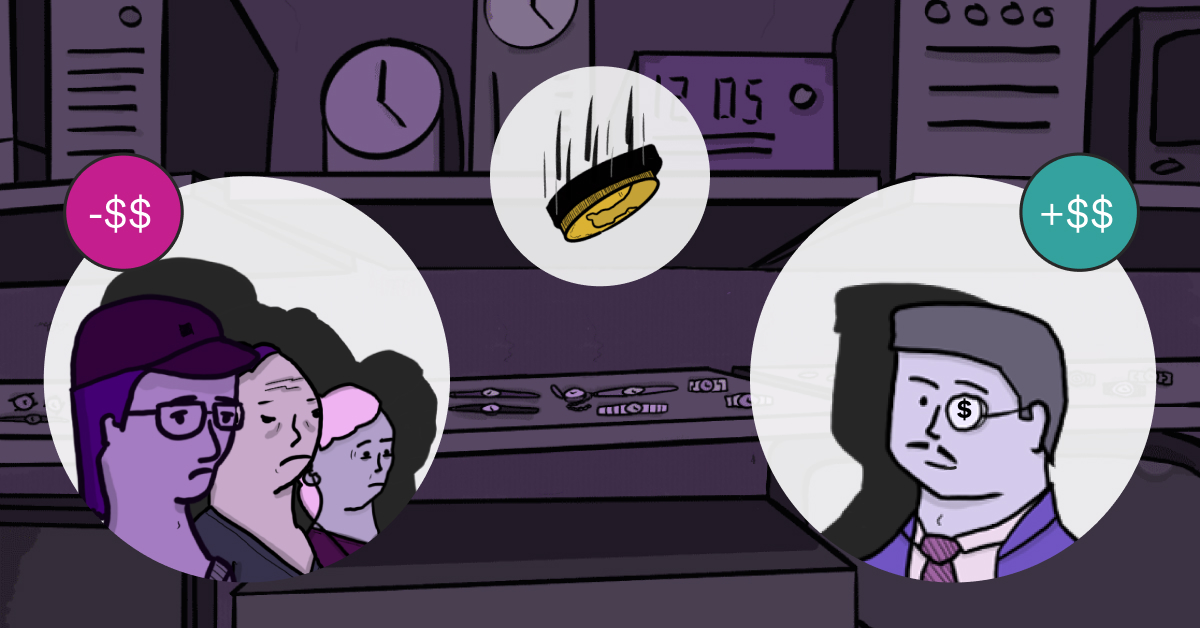


The meme is fine, it’s the comments. If a business is following the law, the business must pass along the full amount of donated money, and does not get a tax deduction. I tried to look up some numbers, and found that many companies do not even report the amounts they collect, so they’re not doing it for media coverage. Agree with me or not, those are the facts.